MECCACOIN's "No Interest" Magic – Breaking Down the Impossible DeFi Model
The intersection of blockchain technology and Islamic finance has long been considered an impossible puzzle—until now. MECCACOIN represents a groundbreaking approach to decentralized finance that eliminates riba (interest) entirely while maintaining the efficiency and innovation that makes DeFi revolutionary. This technical explainer breaks down exactly how this "riba-free magic" works and why it matters for the future of ethical finance.
Understanding the Core Problem: Why Traditional DeFi Fails Islamic Finance
Traditional DeFi protocols generate returns through interest-based lending mechanisms that directly contradict Islamic financial principles. Islam strictly forbids the charging or payment of interest, as it is considered exploitative and unjust. Most yield farming, liquidity mining, and staking protocols on conventional platforms operate through structures that Islamic scholars categorize as riba—returning more money than was deposited based purely on the passage of time rather than genuine economic activity.
The challenge isn't simply avoiding the word "interest." If your rewards come from someone borrowing money and paying it back with interest, even if it's hidden through inflation or token incentives, that still conflicts with Islamic principles. This means the entire architecture of how returns are generated must be reimagined from the ground up.
The Three Prohibitions Every Islamic DeFi Must Navigate
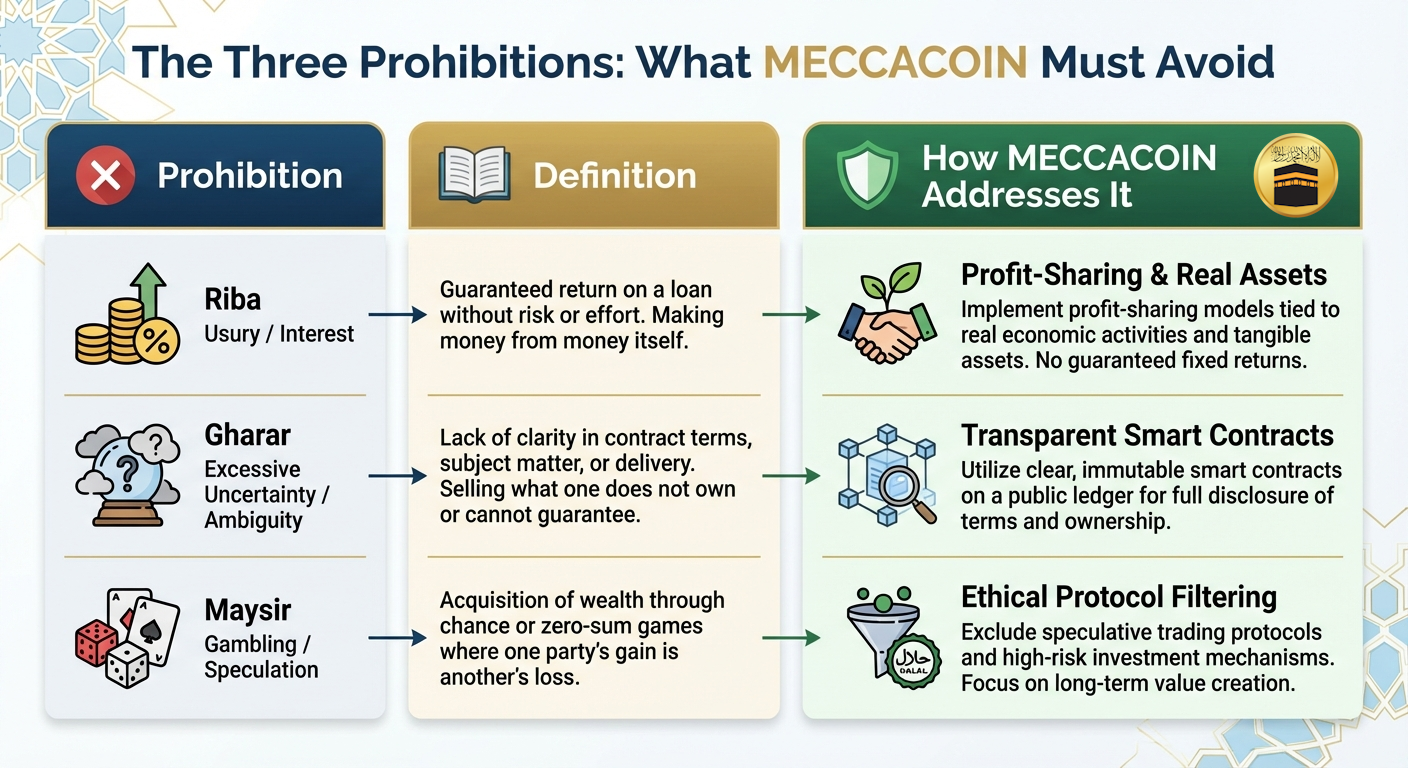
Alt Text: Infographic showing the three Islamic finance prohibitions—Riba (interest), Gharar (uncertainty), and Maysir (gambling)—with definitions and how MECCACOIN addresses each through profit-sharing, transparent smart contracts, and ethical protocol filtering.
MECCACOIN's technical architecture specifically addresses the three core prohibitions in Islamic finance:
Riba (Interest): Any guaranteed return on capital without corresponding risk or productive activity violates this principle. Scholars have consistently stressed that receiving rewards resembling interest, such as staking rewards structured as fixed returns, goes against the principles of Shariah.
Gharar (Excessive Uncertainty): Contracts with ambiguous terms, unclear deliverables, or speculative elements that border on gambling are prohibited. All participants in a financial transaction must be fully informed and comfortable with its terms and conditions before proceeding.
Maysir (Gambling): Any transaction that resembles a zero-sum game where one party's gain directly results from another's loss violates this principle.
The MECCACOIN Technical Framework: Building Riba-Free Architecture
MECCACOIN achieves its "impossible" no-interest model through a sophisticated combination of blockchain architecture, smart contract design, and profit-sharing mechanisms rooted in classical Islamic finance contracts.
Solana Blockchain: The Foundation of Speed and Efficiency
MECCACOIN is built on the Solana blockchain, leveraging its high-speed transactions, low fees, and scalability to create a seamless Sharia-compliant digital financial environment. The choice of Solana isn't arbitrary—its technical specifications align remarkably well with Islamic finance requirements:
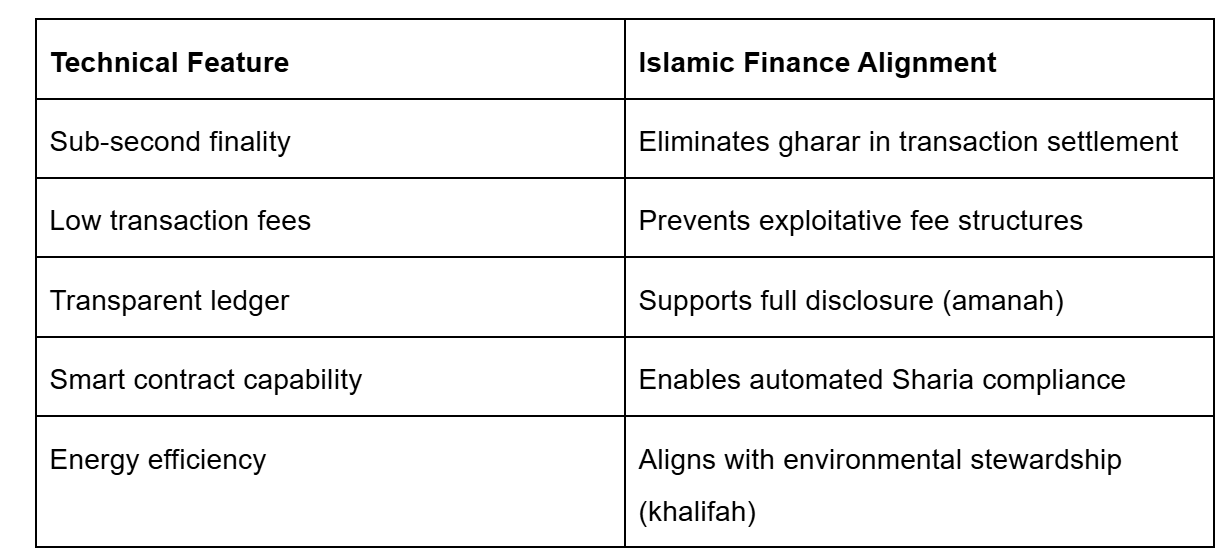
The SPL-20 token standard used by MECCACOIN ensures that all token movements are recorded immutably on-chain, providing the transparency that Islamic finance demands.
Smart Contracts for Ethical Agreements
MECCACOIN utilizes blockchain-based smart contracts to facilitate transparent and ethical financial agreements. These self-executing contracts are programmed to adhere to Islamic principles, automatically excluding haram industries such as gambling, alcohol, and speculative trading.
The smart contract architecture implements several critical compliance layers:
- Transaction Filtering: Contracts automatically reject interactions with known haram protocols
- Profit Distribution Logic: Returns are calculated based on actual economic activity, not time-based interest
- Charitable Allocation: 10% of transaction value is programmatically directed to zakat and sadaqah
- Audit Trail: Every transaction is permanently recorded for Sharia committee review
Profit-Sharing vs. Interest: The Technical Distinction
The "magic" of MECCACOIN's no-interest model lies in understanding the fundamental difference between Islamic profit-sharing and conventional interest. This isn't semantic wordplay—it represents entirely different economic structures.
How Conventional DeFi Generates "Interest"
In traditional DeFi lending protocols, the mechanism works like this:
- User deposits assets into a lending pool
- Borrowers pay a fixed percentage rate to access those assets
- Depositors receive a guaranteed return regardless of what borrowers do with the funds
- The platform takes a cut as an intermediary
This structure is problematic because the return is predetermined and disconnected from productive economic activity. The key difference often cited is that staking rewards should be for an active service, not a passive loan.
MECCACOIN's Profit-Sharing Alternative
MECCACOIN's approach mirrors classical Islamic contracts like Mudarabah and Musharakah, adapted for blockchain implementation:
In a Mudarabah contract, the financier provides 100% of the capital while the other party provides labor, and both share in the profits. Profits generated are shared between the parties according to a pre-agreed ratio.
When translated to blockchain architecture, this means:
- Capital providers stake assets that enable real economic activity
- Working partners (validators, developers, ecosystem participants) use those assets productively
- Profits are shared based on actual economic outcomes, not predetermined rates
- Losses are shared according to the capital contribution ratio
In Musharakah, all partners share the profit or loss of their joint enterprise. Profit is shared based on the pre-agreed profit sharing ratio, while loss is shared as per the capital contribution ratio.
This risk-sharing element is critical. Unlike conventional interest where the lender is guaranteed return regardless of outcome, Islamic profit-sharing means capital providers participate in both upside and downside.
The Sharia Committee: Technical Oversight for Continuous Compliance
MECCACOIN's operations are supervised by a dedicated Islamic Sharia Committee comprising scholars from Al-Azhar Al-Sharif and other recognized Islamic institutions. This isn't ceremonial—the committee performs ongoing technical audits of the protocol's mechanisms.
Committee Responsibilities
The committee ensures compliance across multiple dimensions:
Smart Contract Certification: Every financial mechanism of MECCACOIN, from smart contracts to tokenomics, is reviewed and certified. The committee evaluates the absence of riba in all transactions, the elimination of gharar in contracts and exchanges, and the prohibition of haram activities.
Transaction Supervision: All buying, selling, transferring, and depositing activities using MECCACOIN are monitored and audited under direct Sharia Committee supervision. This ensures users can engage in halal financial transactions with full confidence.
Continuous Guidance: Platforms claiming to be halal need regular audits, not just a one-time fatwa. MECCACOIN's committee provides ongoing Islamic financial guidance, ensuring the protocol remains a righteous and ethical financial instrument as it evolves.
Distinguished Scholars on the Committee
The committee includes scholars with deep expertise in both classical Islamic jurisprudence and modern financial applications:
- Sheikh Dr. Tariq Nasr – Chief Researcher at Al-Azhar Al-Sharif, specializing in Islamic economic systems and digital asset jurisprudence
- Prof. Dr. Hamdi Sobhi Taha – Member of the Council of Senior Scholars at Al-Azhar Al-Sharif, adviser on modern applications of Islamic finance
- Prof. Dr. Jalal Al-Din Ismail Hassan – Member of the Council of Senior Scholars at Al-Azhar Al-Sharif, expert in Sharia governance and digital finance compliance
Tokenomics Designed for Ethical Distribution
MECCACOIN's tokenomics reflect Islamic principles of fair distribution and community benefit. With a total supply of 3 billion tokens, the allocation prioritizes accessibility and liquidity over insider enrichment:

The capped, non-mintable supply prevents inflationary mechanisms that could function as hidden interest. Once all tokens are distributed, no additional supply can be created—ensuring that value appreciation comes from genuine utility growth rather than monetary expansion.
Integrated Zakat and Sadaqah: Automated Charitable Giving
One of MECCACOIN's most innovative features is its automated charitable allocation system. A portion of transaction value is automatically directed to verified humanitarian causes, making the fulfillment of Islamic charitable obligations seamless.
Technical Implementation
The zakat and sadaqah system works through smart contract logic:
- Transaction Initiation: User initiates any MECCACOIN transaction
- Automatic Calculation: Smart contract calculates the charitable portion
- Transparent Allocation: Funds are directed to verified charity wallets
- On-Chain Recording: All contributions are permanently recorded for auditability
All charitable contributions are verified, transparent, and traceable on the blockchain, ensuring that funds reach those in need without intermediaries. This transparency addresses a common concern in traditional charitable giving—uncertainty about whether donations actually reach intended recipients.
Security Architecture: Third-Party Validation
MECCACOIN has undergone rigorous security audits from industry-leading firms, providing independent verification of both technical security and operational integrity:
- Coinsult (Netherlands): Completed external audit confirming the protocol is 100% secure
- CertiK: The world's leading blockchain security company audited MECCACOIN and confirmed it meets the highest security standards
- SolidProof (Germany): Completed team KYC verification, establishing accountability and trust
These audits verify not just security but also that the technical implementation matches the stated Sharia-compliant design.
Practical Applications: How Users Interact with the No-Interest Model
Understanding the theory is important, but users need to know how this translates to practical use cases.
Halal Digital Payments
MECCACOIN enables quick, secure, and interest-free transactions for goods and services globally. Payments made using MECCACOIN are fully transparent, recorded on the blockchain, and free from unethical financial practices. Businesses and e-commerce platforms that adhere to Sharia-compliant practices can accept MECCACOIN as a halal payment method.
Cross-Border Remittances
MECCACOIN eliminates the need for interest-based banking by offering a cost-effective, decentralized solution for cross-border payments. Users can transfer money internationally instantly without relying on financial institutions that operate with riba. This is especially beneficial for Muslims working abroad who want to send remittances home in a Sharia-compliant manner.
Halal Investment and Wealth Growth
MECCACOIN provides a platform for Sharia-compliant investment opportunities, allowing users to grow their wealth ethically. Unlike conventional investment models involving interest-based profits, MECCACOIN follows Islamic finance principles such as Mudarabah (profit-sharing) and Musharakah (joint ventures).
The Future Roadmap: Expanding the Impossible
MECCACOIN's development roadmap outlines continued expansion of its riba-free ecosystem:
Phase 3 – Platform Development: Development of the MECCACOIN Wallet for secure storage and transactions, integration of Zakat & Sadaqah donation features, and establishment of a transparent charitable fund allocation system.
Phase 4 – Ecosystem Expansion: Launch of Sharia-compliant staking and savings options, cross-border remittances with minimal fees, and business e-commerce integrations for halal transactions.
Phase 5 – Global Expansion: Expansion into Islamic-majority regions, regulatory approvals for global adoption, and partnerships with Islamic banks and fintech providers.
Conclusion: Why "Impossible" DeFi Is Now Possible
MECCACOIN demonstrates that the apparent impossibility of riba-free DeFi was never a technical limitation—it was a design choice. By architecting blockchain protocols from the ground up around Islamic finance principles rather than trying to retrofit conventional DeFi, MECCACOIN creates genuine alternatives to interest-based returns.
The combination of Solana's technical capabilities, smart contracts designed for ethical compliance, ongoing Sharia committee oversight, and profit-sharing mechanisms rooted in classical Islamic contracts creates a financial ecosystem where Muslims can participate confidently in the digital economy.
By leveraging blockchain, Islamic finance contracts like Musharakah and Mudarabah are no longer constrained by conventional limitations such as geographic boundaries, operational inefficiencies, and challenges in trust establishment between parties.
The "magic" of MECCACOIN's no-interest model isn't magic at all—it's careful technical architecture aligned with timeless ethical principles. For the global Muslim community seeking halal alternatives in the rapidly expanding digital economy, MECCACOIN represents not just a cryptocurrency but a movement toward financial justice and ethical banking.