MECCACOIN vs Traditional Islamic Finance – The DeFi Revolution
Blockchain halal finance is transforming how Muslims access Sharia-compliant financial services globally. As the Islamic finance industry approaches $4.9 trillion in assets and DeFi protocols mature, a convergence is emerging that promises to solve decades-old structural problems. This technical comparison examines how MECCACOIN innovation addresses the fundamental limitations of traditional Islamic finance through decentralized architecture.
Understanding Traditional Islamic Finance Architecture
Traditional Islamic finance operates through centralized institutions governed by Sharia principles prohibiting interest, uncertainty, and unethical investments. The sector has demonstrated remarkable growth, with Islamic finance assets totaling $3.5 trillion in 2024, projected to exceed $8 trillion by 2032, reflecting strong global demand for ethical financial services.
Core Operational Principles
Islamic financial institutions structure products around five foundational rules:
- Prohibition of Riba (Interest): All lending must use profit-sharing rather than fixed interest rates
- Avoidance of Gharar (Uncertainty): Contracts require complete transparency with no hidden terms
- Exclusion of Maysir (Speculation): Derivatives, margin trading, and gambling are forbidden
- Asset-Backing Requirements: Transactions must involve tangible assets or real economic activity
- Ethical Screening: Investments cannot support alcohol, gambling, tobacco, or weapons
These principles create robust ethical frameworks but also introduce operational complexity that limits scalability.
Structural Limitations of Conventional Islamic Banking
Despite strong growth metrics, traditional Islamic finance faces persistent technical and operational challenges that constrain its potential.
Islamic finance lacks uniform global standards for products, contracts, and regulations. Different countries and institutions follow varying interpretations of Sharia principles, creating fragmentation that increases compliance costs and slows cross-border transactions.
Islamic financial institutions face challenges in managing liquidity due to the limited availability of Sharia-compliant liquidity management instruments. Traditional tools like interbank lending are not permissible under Sharia, forcing institutions to rely on less efficient alternatives that constrain balance sheet flexibility.
Key technical constraints include:
- Standardization Gaps: No unified framework for contract structures across jurisdictions
- Liquidity Management: Limited Sharia-compliant instruments for short-term funding needs
- Talent Shortage: The demand for additional Sharia scholars who are well-versed in contemporary finance exceeds supply
- Higher Transaction Costs: Multi-layer structuring requirements increase operational expenses
- Limited Global Integration: Structural differences restrict cross-border capital flows
The Emergence of Islamic DeFi
Decentralized finance protocols are creating new pathways for Sharia-compliant financial services by eliminating intermediaries while maintaining ethical compliance through code.
Blockchain Alignment with Islamic Principles
Unlike conventional DeFi, Islamic DeFi eliminates interest-based transactions, excessive uncertainty, and speculation while ensuring all financial activities comply with Sharia law.
The technical architecture of blockchain networks provides inherent alignment with Islamic finance requirements:
Transparency Through Immutability: Every transaction records permanently on-chain, creating auditable trails that satisfy gharar avoidance requirements. Users and Sharia supervisors can verify compliance in real-time rather than through periodic audits.
Smart Contract Automation: Smart contracts allow financial agreements to be programmed directly onto the blockchain. In an Islamic context, they can automate profit-sharing agreements, ensure transactions involve tangible assets, and restrict activities that violate Sharia law.
Decentralized Risk Distribution: Rather than concentrating risk in central institutions, blockchain protocols distribute it across network participants—aligning with the Islamic finance principle of shared profit-and-loss.
Market Trajectory and Institutional Recognition
The Islamic DeFi sector is experiencing rapid adoption. The Islamic fintech sector, valued at USD 138 billion in 2024 and projected to exceed USD 300 billion by 2027, is transforming service delivery and introducing alternative intermediation channels beyond traditional banking.
Academic research supports this trajectory. The findings indicate that 59% of studied texts exhibit positive sentiments toward DeFi, reflecting academic confidence in its potential advancements and benefits for the financial sector.
MECCACOIN Technical Architecture
MECCACOIN represents a purpose-built implementation of Islamic DeFi principles on high-performance blockchain infrastructure. Built on the Solana network, it combines Sharia compliance with technical specifications optimized for global-scale transactions.
Solana Foundation: Speed and Cost Efficiency
The choice of Solana as the underlying blockchain provides critical technical advantages for Islamic finance applications:
Just like Ethereum, Solana is a decentralised network using blockchain technology that allows developers to build decentralised applications and utilise smart contracts.
Solana's Proof-of-History (PoH) consensus mechanism creates a verifiable timeline of transactions. Each transaction is linked to the one before it, producing a clear and transparent sequence of events. This reduces uncertainty and builds trust, which is an important factor in Islamic finance where avoiding gharar (excessive ambiguity) is essential.
Performance specifications make MECCACOIN viable for high-volume payment processing:
- Transaction Speed: Up to 50,000 TPS theoretical maximum
- Confirmation Time: Sub-second finality
- Transaction Costs: Approximately 0.000005 SOL per transaction (fractions of a cent)
- Token Standard: SPL-20 for native Solana compatibility
Token Economics and Distribution
MECCACOIN implements a fixed supply model with transparent allocation:
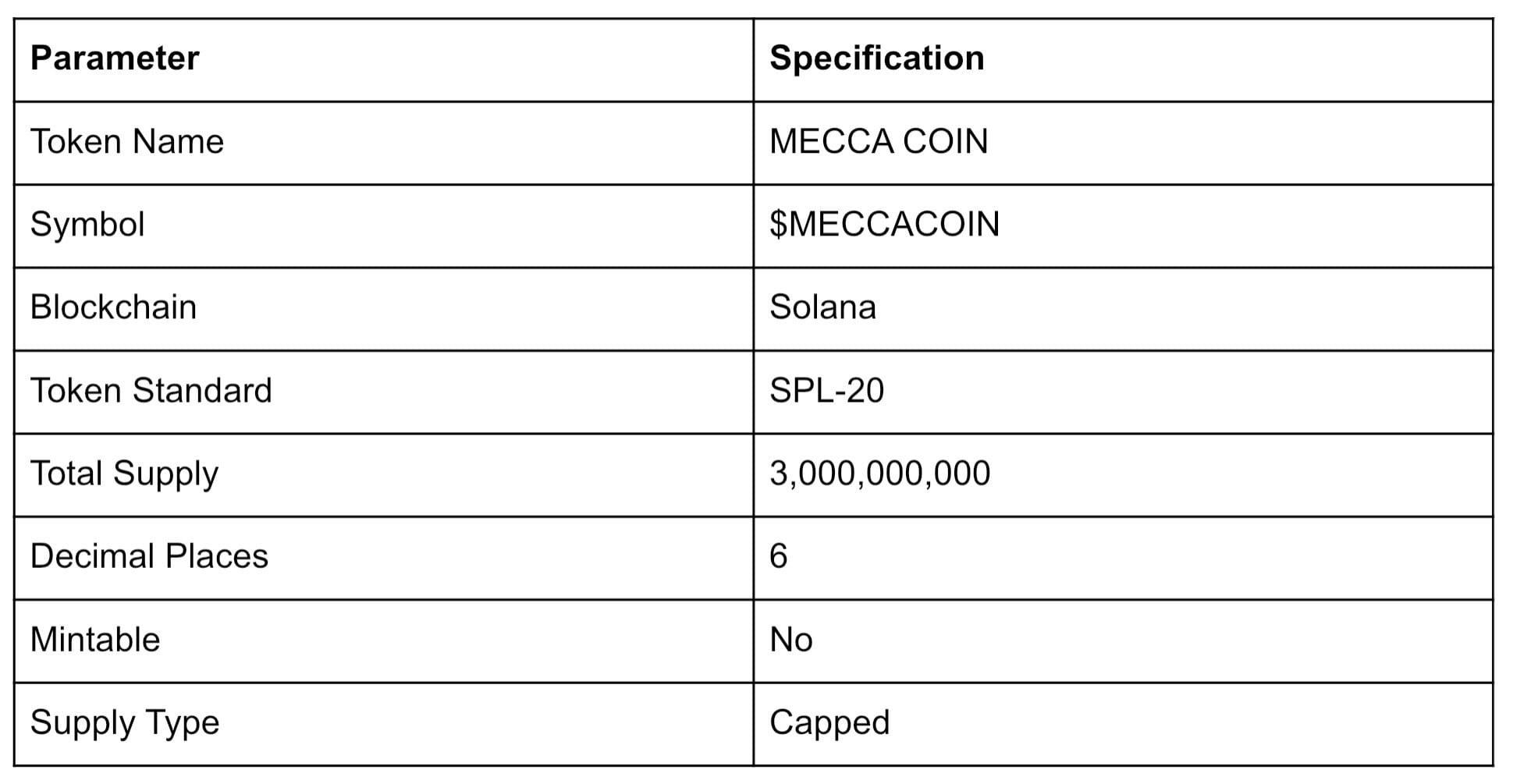
Distribution Allocation:
- 40% Public Sale – Community acquisition through presale mechanisms
- 35% Liquidity Pool – DEX trading pair depth
- 15% Marketing & Growth – Ecosystem development initiatives
- 10% Team & Advisors – Vested allocation for core contributors
The non-mintable, capped supply ensures no inflationary dilution—a design choice that aligns with Islamic principles of fair value preservation.
Sharia Compliance Infrastructure
MECCACOIN's compliance architecture operates at multiple technical and governance layers.
Sharia Committee Oversight: All financial mechanisms undergo review by a dedicated Islamic Sharia Committee comprising scholars from Al-Azhar Al-Sharif. Committee members include:
- Sheikh Dr. Tariq Nasr – Chief Researcher at Al-Azhar Al-Sharif, specialist in Islamic economic systems and digital asset jurisprudence
- Prof. Dr. Hamdi Sobhi Taha – Member of the Council of Senior Scholars at Al-Azhar Al-Sharif, expert in Fiqh al-Mu'amalat (Islamic financial transactions)
- Prof. Dr. Jalal Al-Din Ismail Hassan – Member of the Council of Senior Scholars at Al-Azhar Al-Sharif, authority on Sharia governance for financial institutions
Automated Zakat & Sadaqah Integration: The protocol allocates 10% of token value to charitable causes supporting humanitarian relief in Islamic communities. This implementation transforms charitable giving from manual processes to automated, transparent fund distribution recorded immutably on-chain.
Haram Activity Exclusion: Smart contract logic restricts transactions involving prohibited activities including gambling, alcohol, and speculative instruments.
Security Verification Stack
MECCACOIN has completed comprehensive third-party security validation:
- Coinsult Audit – Full smart contract security review (Completed)
- CertiK Audit – Blockchain security verification by industry-leading firm (Completed)
- Solidproof KYC – Team identity verification (Completed)
This multi-auditor approach addresses the trust deficit that has historically constrained Islamic finance adoption.
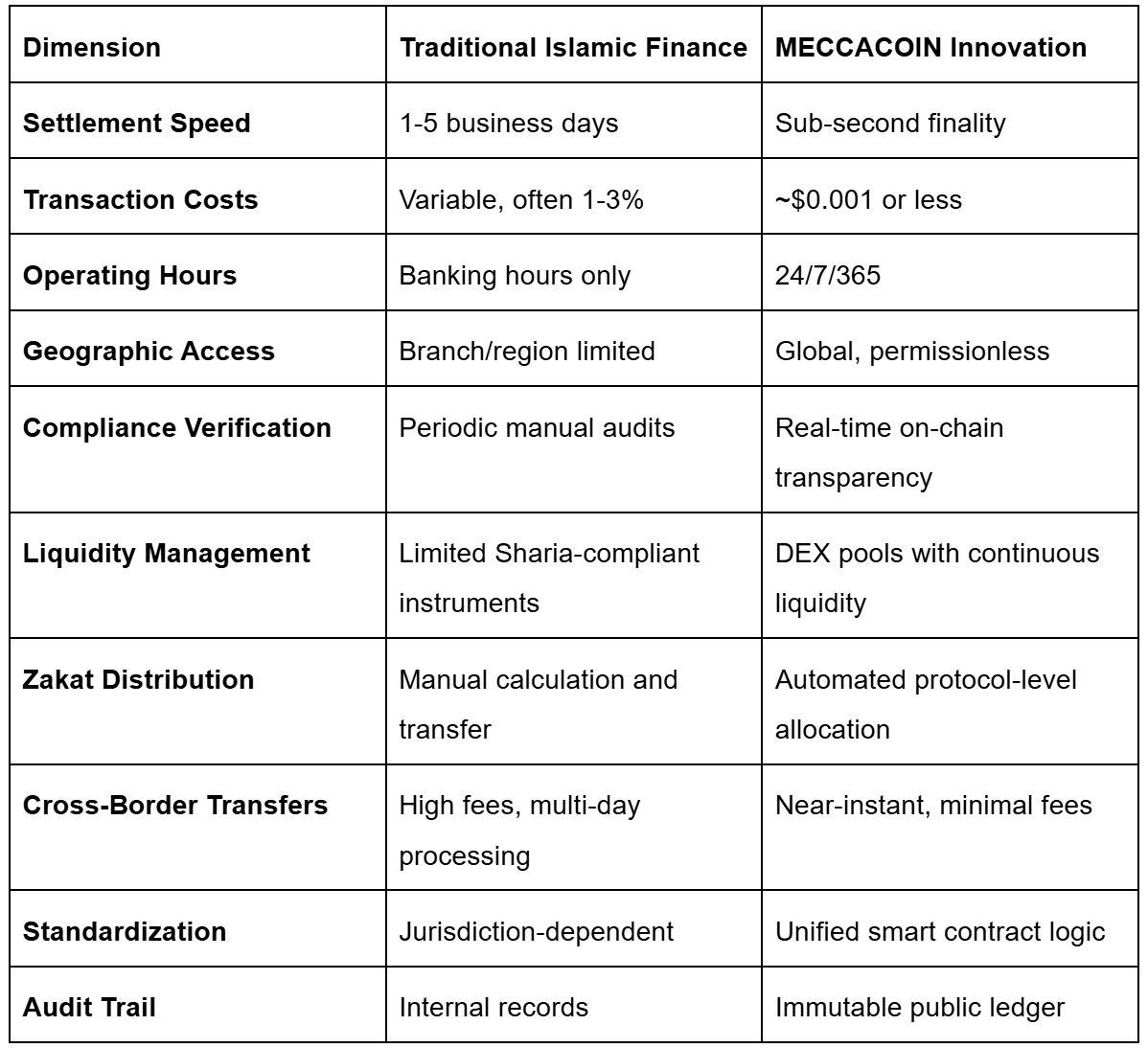
Technical Comparison: Traditional vs Blockchain Halal Finance
The following matrix illustrates architectural differences between conventional Islamic banking infrastructure and MECCACOIN's DeFi implementation:
Developer Integration Pathways
For technical teams building on MECCACOIN infrastructure, the Solana ecosystem provides robust development tooling.
Smart Contract Development
Solana programs can be written in Rust, C, or C++, compiled to BPF bytecode for on-chain execution. The SPL-20 token standard ensures MECCACOIN interoperability with existing Solana DeFi protocols, wallets, and exchange integrations.
Key development resources:
- Solana Playground (Solpg): Browser-based IDE for program development
- Anchor Framework: Rust framework simplifying Solana program development
- SPL Token Library: Standard implementations for token operations
API Integration Points
MECCACOIN supports standard Solana RPC endpoints for:
- Balance queries and transaction submission
- Token transfer operations
- Transaction history retrieval
- Real-time websocket subscriptions
Developers can integrate MECCACOIN payments into e-commerce platforms, remittance services, and Islamic fintech applications using familiar Solana development patterns.
Ecosystem Roadmap: From Payments to Islamic DeFi
The MECCACOIN development trajectory follows a phased expansion:
Phase 1-2 (Foundation): Completed phases including Sharia Committee formation, smart contract development on Solana, security audits, and token launch.
Phase 3 (Core Features): Development of secure wallet infrastructure, halal digital payment enablement, and zakat/sadaqah donation integration with transparent fund allocation.
Phase 4 (DeFi Expansion): Sharia-compliant staking and savings options, cross-border remittance services with minimal fees, and business/e-commerce integration for halal transactions.
Phase 5 (Global Scale): Market expansion into Islamic-majority regions across Middle East, North Africa, and Southeast Asia, regulatory compliance certification, and partnerships with Islamic banks and fintech providers.
Future scope includes tokenization of Islamic assets, microfinance and crowdfunding platforms, educational resources on Islamic finance, and Sharia-compliant virtual trading infrastructure.
The Convergence Thesis: Why Blockchain Halal Finance Matters
The structural limitations of traditional Islamic finance—standardization gaps, liquidity constraints, talent shortages, and geographic fragmentation—represent solvable technical problems rather than fundamental barriers.
With the global Islamic finance industry valued at over $4.9 trillion, the question isn't whether we should bridge this gap, but how.
Blockchain architecture provides the technical substrate for solutions:
Standardization Through Code: Smart contracts enforce consistent rules across all transactions regardless of jurisdiction, eliminating interpretation variance that fragments traditional Islamic finance.
Programmable Compliance: Smart contracts are closer to Islamic contracts with an undiluted focus on avoidance of any kind of uncertainty regarding settlement of the contracts.
Global Accessibility: Permissionless networks enable participation from any location with internet access, extending Sharia-compliant services to underserved Muslim populations worldwide.
Transparent Governance: On-chain visibility satisfies the Islamic finance requirement for complete transaction transparency while enabling continuous rather than periodic compliance verification.
Conclusion: A Technical Foundation for Ethical Finance
The comparison between traditional Islamic finance and blockchain halal finance reveals complementary rather than competitive systems. Traditional institutions provide established trust frameworks, regulatory relationships, and institutional credibility. Blockchain protocols provide technical infrastructure for speed, transparency, cost efficiency, and global accessibility.
MECCACOIN innovation demonstrates how these domains can converge—implementing Islamic financial principles in high-performance smart contract architecture while maintaining scholarly oversight and charitable integration. As the industry performance during 2025 reflected both continuity and transition, the Islamic DeFi category represents the highest-growth segment of an already expanding market.
For developers, investors, and institutions evaluating Islamic finance vs DeFi infrastructure, MECCACOIN offers a production-ready implementation combining Solana's technical capabilities with comprehensive Sharia compliance verification.
Explore MECCACOIN at https://meccacoin.meme/
This article is for informational purposes only and does not constitute financial or investment advice. Cryptocurrency investments carry risk. Always conduct your own research and consult qualified professionals before making investment decisions.