Play-to-Earn Casinos vs Traditional Gambling: Which Pays More?
The online gambling landscape is experiencing a revolutionary transformation in 2026, with play-to-earn casino models challenging century-old traditional gambling paradigms. As blockchain technology merges with casino gaming, players now face a critical choice: stick with conventional platforms where the house always wins, or embrace P2E gambling ecosystems where every bet builds real value. This comprehensive guide reveals which model actually puts more money in your pocket.
Understanding the Play-to-Earn Casino Revolution
Play-to-earn casinos fundamentally reimagine the player-casino relationship by rewarding ongoing participation, not just wins. Unlike traditional gambling platforms where your money disappears into the house coffers, P2E gambling creates token economies that share revenue with active players through rakeback, staking rewards, and governance participation.
The numbers tell a compelling story. Web3 gaming accounted for 25% of all active blockchain wallets in Q3 2026, up from 20.1% in Q2. The crypto casino industry reached $81.4 billion in revenue in 2026, projected to grow at 27.29% annually through 2032. This isn't just another crypto trend—it's a fundamental restructuring of how online gambling creates and distributes value.
Traditional casinos operate on a simple premise: players wager money, the house edge guarantees long-term casino profits, and winners walk away with payouts while losers get nothing. P2E gambling flips this model by introducing utility tokens, mission-based rewards, tiered loyalty systems, and staking mechanisms that transform casual players into ecosystem stakeholders who earn regardless of individual game outcomes.
What Makes GambleFi Different from Traditional Online Casinos
GambleFi represents the convergence of decentralized finance protocols with casino operations, creating hybrid platforms where gambling meets DeFi yields. The distinction goes far beyond simply accepting cryptocurrency payments—it's about rebuilding casino economics from the ground up using blockchain transparency and smart contract automation.
Traditional online casinos control your funds the moment you deposit, process withdrawals slowly through banking intermediaries, obscure house edge calculations behind proprietary algorithms, and offer loyalty points that lack real monetary value. GambleFi platforms execute instant deposits and withdrawals through blockchain transactions, provide provably fair gaming where every outcome can be independently verified, distribute native tokens that players can trade or stake for passive income, and enable governance rights where token holders vote on platform decisions.
The infrastructure differences create profound implications for player returns. Traditional casinos typically operate with 5-10% margins on gross gaming revenue, paying nothing back to losing players. GambleFi platforms trim fees to approximately 1% by eliminating intermediaries, then redistribute substantial portions of profits through token buybacks, staking rewards, and rakeback programs that benefit all participants.
Consider the transparency advantage: blockchain casinos record every bet, outcome, and payout immutably on-chain. Players can verify game fairness using cryptographic proofs rather than trusting casino claims.
The Real Economics: Comparing Actual Earnings Potential
Let's analyze the mathematics that determine which model actually pays more by examining multiple earning streams available in each ecosystem.
Traditional Casino Revenue Streams
Traditional online gambling offers exactly one way to make money: winning individual games. Your expected returns depend entirely on house edge percentages built into each game. Slot machines typically pay 94-97% return to player (RTP), table games like blackjack offer 98-99.5% RTP with optimal strategy, roulette provides approximately 97.3% RTP on European variants, while poker rooms charge 5-10% rake on pots.
Even high-roller VIP programs at traditional casinos primarily offer comp points exchangeable for free play, expedited withdrawals, and luxury perks—benefits that don't fundamentally alter the negative expected value of gambling itself. If you wager $10,000 monthly at 96% RTP, you'll statistically lose $400 despite any VIP status.
Play-to-Earn Casino Revenue Streams
P2E gambling multiplies earning opportunities beyond simple win/loss outcomes through token economies designed to reward participation:
Rakeback rewards return 5-20% of total wagered amounts regardless of results. If you bet $10,000 monthly with 10% rakeback, you automatically earn $1,000 in tokens that can be withdrawn or reinvested.
Staking yields generate passive income on token holdings. Leading platforms offer 15-500% annual percentage rates through revenue-sharing mechanisms where stakers receive portions of casino profits. Staking $5,000 worth of tokens at 100% APR produces $5,000 annual passive income independent of gambling activity.
Loyalty tier progression unlocks escalating benefits as you accumulate platform tokens through play. Higher tiers provide increased cashback percentages, reduced wagering requirements, exclusive tournament access, and priority withdrawal processing that compound your effective returns.
Mission completion bonuses reward specific actions like playing certain games, achieving win streaks, or maintaining daily activity. These structured rewards transform routine gambling into achievement-based earning opportunities.
Token appreciation creates potential investment gains as platform success drives token value increases. Early adopters of successful GambleFi tokens have seen 10-100x returns separate from gambling outcomes.
The mathematical reality becomes clear: even if you lose the same percentage on individual games, P2E gambling creates multiple compensating revenue streams that can turn negative expected value into positive total returns. A player wagering $10,000 monthly might lose $400 from house edge, but earn $1,000 from rakeback, $500 from staking, and $500 from missions—netting +$1,600 monthly versus -$400 under traditional models.
How Play-to-Earn Mechanisms Actually Work
Understanding the technical infrastructure behind P2E gambling helps players maximize earnings by leveraging every available mechanism.
Utility Token Economics
Native casino tokens serve as the central hub connecting all earning activities. When you place bets, smart contracts automatically calculate and distribute token rewards based on wagered amounts and current rakeback percentages. These tokens function as real cryptocurrency that can be held in your personal wallet, traded on decentralized exchanges, staked for yield farming, or converted to Bitcoin, Ethereum, or stablecoins.
Staking Infrastructure
Staking transforms tokens from simple loyalty points into income-producing assets. Players lock tokens for predetermined periods (typically 7-180 days) in exchange for yields derived from casino profits. Three staking models dominate current GambleFi platforms: fixed-term staking offers highest APRs but locks tokens completely, flexible staking provides lower returns with instant unstaking options, and auto-compounding stakes that reinvest rewards automatically for exponential growth.
Loyalty Progression Systems
Multi-tier loyalty programs create achievement-based progression where accumulated tokens unlock permanent status upgrades. Each tier delivers escalating benefits that compound with existing earning mechanisms. Entry tiers might offer 5% rakeback and 1.5x staking multipliers, while platinum tiers provide 15% rakeback, 5x staking multipliers, no-wager cashback, and exclusive tournament access.
Mission and Achievement Frameworks
Structured challenges transform daily gambling into goal-oriented activities with guaranteed token payouts. Missions range from simple tasks like "play 100 spins today" (reward: 50 tokens) to complex achievements like "reach 10-win streak on live blackjack" (reward: 500 tokens). Achievement systems complement missions with permanent milestones that trigger bonus token distributions.
CASA Casino: Where P2E Meets Premium Gaming Experience
For players seeking a sophisticated entry into play-to-earn gambling, examining how established platforms implement these concepts provides valuable insights into what effective P2E execution looks like in practice.
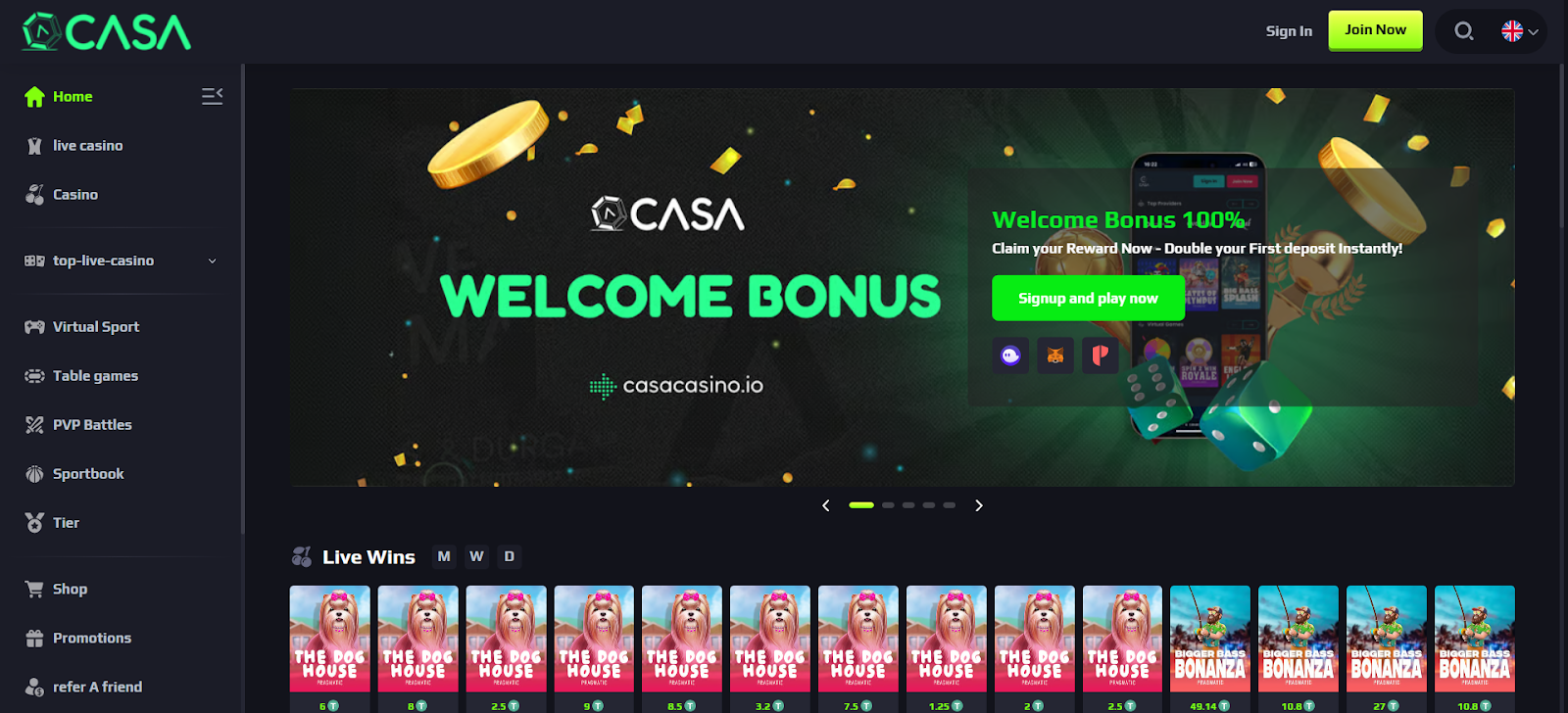
Alt text: CASA Casino homepage showcasing the platform's P2E-integrated interface with navigation featuring tier progression, promotions, and referral programs alongside traditional casino sections. The welcome bonus banner highlights the 100% first deposit match, while the Live Wins ticker displays real-time player payouts from popular slots, demonstrating the platform's active player ecosystem.
Modern blockchain-powered casinos demonstrate that play-to-earn mechanics can coexist with premium gaming experiences, comprehensive game libraries, and robust player protections. When evaluating P2E opportunities, players should prioritize platforms offering transparent token economics where reward calculations are publicly verifiable, diverse earning mechanisms beyond simple rakeback, established regulatory licensing that ensures player protection, provably fair gaming infrastructure for outcome verification, and instant cryptocurrency withdrawals that eliminate banking friction.
CASA Casino exemplifies this balanced approach by integrating blockchain benefits with comprehensive gambling options. The platform operates under Anjouan Gaming Authority licensing, providing regulatory oversight while maintaining the crypto flexibility that enables genuine P2E economics. Security measures including Solidproof.io auditing, SSL encryption, and cold wallet storage protect both traditional gameplay and token-based earning activities.
The $CASA token ecosystem creates multiple earning pathways familiar to P2E veterans while remaining accessible to newcomers. Players enjoy up to 20% weekly rakeback distributed automatically based on wagering activity, staking opportunities that generate passive yields from platform revenues, exclusive promotions available only to token holders, and cashback rewards that soften losing sessions. This token integration happens seamlessly within a comprehensive platform offering 10,000+ games from elite providers like Pragmatic Play, Microgaming, and NetEnt.
What distinguishes thoughtfully designed P2E implementations is how they enhance rather than complicate the gambling experience. Players access the full game library through familiar interfaces while token rewards accumulate automatically in the background.
The platform's VIP program demonstrates how P2E concepts elevate conventional loyalty structures. Rather than opaque point systems, progression is tied directly to $CASA token accumulation, creating transparent advancement criteria. Higher tiers deliver tangible benefits including increased withdrawal limits, personalized account management, enhanced cashback percentages, and priority access to new games.
Cryptocurrency integration extends beyond token rewards to fundamental platform operation. Support for 15+ cryptocurrencies including Bitcoin, Ethereum, USDT, Litecoin, Dogecoin, and XRP provides payment flexibility, while minimum deposits as low as 10 USDT lower entry barriers. Withdrawals process within 36-48 hours—dramatically faster than traditional casinos—and no KYC requirements preserve privacy for players prioritizing anonymity.
Play-to-Earn vs Traditional Gambling: The Practical Reality Check
The theoretical economics of P2E gambling sound compelling, but do they translate into actual player benefits, or is this another crypto promise that fails in practice?
Sustainability Concerns
Critics rightfully question whether platforms can indefinitely sustain 20% rakeback combined with 100%+ staking yields. Successful P2E casinos address sustainability through balanced tokenomics that cap total supply, implement token burning mechanisms that remove circulation, adjust reward rates dynamically based on treasury health, and maintain revenue reserves covering extended reward obligations.
Players should verify that platforms clearly publish tokenomics showing supply schedules, reward funding sources, and economic models. Transparency indicates confidence in sustainability versus opacity suggesting concerning fundamentals.
Regulatory Uncertainty
GambleFi operates in evolving regulatory grey zones where cryptocurrency gambling legality varies by jurisdiction. Forward-thinking platforms obtain proper licensing from established authorities even when operating with cryptocurrencies. Players should prioritize licensed platforms despite potential limitations compared to fully unregulated competitors.
Complexity Barriers
Traditional gambling's simplicity—deposit money, play games, withdraw winnings—contrasts with P2E requirements to manage cryptocurrency wallets, understand token economics, navigate staking interfaces, and track multiple earning streams. The most successful P2E platforms minimize onboarding friction through integrated wallets requiring no external setup, automatic reward distribution eliminating manual claims, and clear dashboards visualizing all earning streams.
Actual Player Results
Analyzing real player experiences reveals P2E gambling's practical outcomes. Early platform adopters commonly report 50-200% total returns combining gambling results with token rewards. Active community members sharing transparent wallets demonstrate consistent monthly profits even during losing gambling streaks—rakeback and staking yields offsetting game losses.
The optimal strategy involves setting token allocation rules before playing: withdraw 50% of earned tokens for profit realization, stake 40% for passive income generation, and retain 10% for platform governance participation.
Choosing Between P2E and Traditional Gambling: Decision Framework
Your ideal platform depends on personal priorities, technical comfort, and financial objectives beyond entertainment.
Choose Traditional Casinos If You Prioritize:
- Regulatory certainty with established legal frameworks and consumer protections
- Simplicity over optimization, preferring straightforward deposit-play-withdraw experiences
- Fiat currency operations avoiding cryptocurrency price volatility and wallet management
- Proven track records from decades-old operators versus newer blockchain platforms
Choose Play-to-Earn Casinos If You Prioritize:
- Maximizing returns through multiple earning streams beyond simple win/loss outcomes
- Transparency provided by blockchain verification and provably fair gaming
- Passive income potential via staking yields and token appreciation
- Financial sovereignty with non-custodial wallets and censorship-resistant transactions
- Privacy through KYC-free accounts preserving anonymity
- Long-term wealth building treating gambling as part of broader crypto portfolio strategy
Maximizing Your Play-to-Earn Earnings: Advanced Strategies
Simply registering at a P2E casino doesn't guarantee superior returns—strategic optimization separates profitable players from those who squander potential earnings.
Token Management Best Practices
Immediately withdrawing all earned tokens for fiat conversion eliminates appreciation potential and staking yields. A balanced allocation might involve: converting 40% to stablecoins monthly for realized profits, staking 40% in medium-term locks (30-90 days) balancing yield and liquidity, holding 15% unstaked for flexibility, and allocating 5% to governance participation.
Staking Duration Optimization
Platforms offer varying yields across staking durations. Optimal strategies ladder stakes across multiple durations rather than concentrating in single timeframes. A $10,000 token portfolio might split: $3,000 in 7-day stakes, $3,000 in 30-day stakes, $2,500 in 90-day stakes, and $1,500 in 180-day stakes. This structure provides regular unlocking dates while capturing substantial long-term yields.
Game Selection for Rakeback Efficiency
Different game categories offer identical house edges but varying rakeback rates. Slots commonly provide highest rakeback (0.5-0.8% of wagered amounts), table games moderate rakeback (0.3-0.5%), and live dealer games lower rakeback (0.2-0.4%). Rakeback-optimized players concentrate volume on high-RTP slots maximizing both direct returns and token earnings.
The Future of Play-to-Earn Gambling: 2026 and Beyond
Current P2E gambling represents early-stage innovation that will evolve dramatically as technology matures and mainstream adoption accelerates.
Regulatory clarity is emerging as jurisdictions develop cryptocurrency-specific gambling frameworks. Cross-platform interoperability enables single tokens functioning across multiple casinos, sportsbooks, and gaming platforms. AI-powered personalization will optimize earning strategies automatically, analyzing your playing patterns to recommend ideal game selections and staking durations. Virtual reality integration creates immersive P2E experiences where physical casino atmosphere meets blockchain economics.
However, token inflation remains an existential risk if platforms issue excessive rewards without corresponding revenue growth. Regulatory crackdowns could restrict P2E operations in major jurisdictions. Market consolidation may concentrate power among few dominant platforms, reducing competition that currently drives generous rewards.
Making Your Decision: Which Model Pays More?
The evidence overwhelmingly demonstrates that properly implemented play-to-earn casinos offer superior financial returns compared to traditional gambling through multiple compensating revenue streams that offset house edge losses.
A player wagering $10,000 monthly at traditional casinos can expect long-term losses of $300-600 depending on game selection. The identical player at a quality P2E platform might experience the same gambling losses but earn $1,000-2,000 monthly through combined rakeback, staking yields, mission bonuses, and token appreciation—transforming -$400 monthly losses into +$600-1,400 monthly profits.
However, these superior returns require active engagement with token economics, disciplined reward management, and comfort with cryptocurrency operations. Players seeking simple entertainment without optimization complexity may prefer traditional casinos despite lower expected returns.
For most readers exploring this guide, the evidence suggests serious consideration of P2E platforms—but starting conservatively. Open accounts at licensed P2E casinos like CASA Casino, deposit modest amounts you're comfortable losing, and experience token economics firsthand. Track your total returns across 3-6 months including gambling results, rakeback, staking yields, and token appreciation. The data will clearly demonstrate whether P2E gambling's superior theoretical economics translate into actual profits for your specific playing patterns.
The gambling landscape has irreversibly transformed. Players who adapt to play-to-earn models position themselves for substantially better financial outcomes than those clinging to traditional paradigms designed purely for casino profit. The choice ultimately is yours—but the mathematics favor evolution.